Blogs
We provide online programming courses and tutorials suitable for all levels.
How to Know If Your Business Has an Automation Problem?
Published on 11 Aug 2026
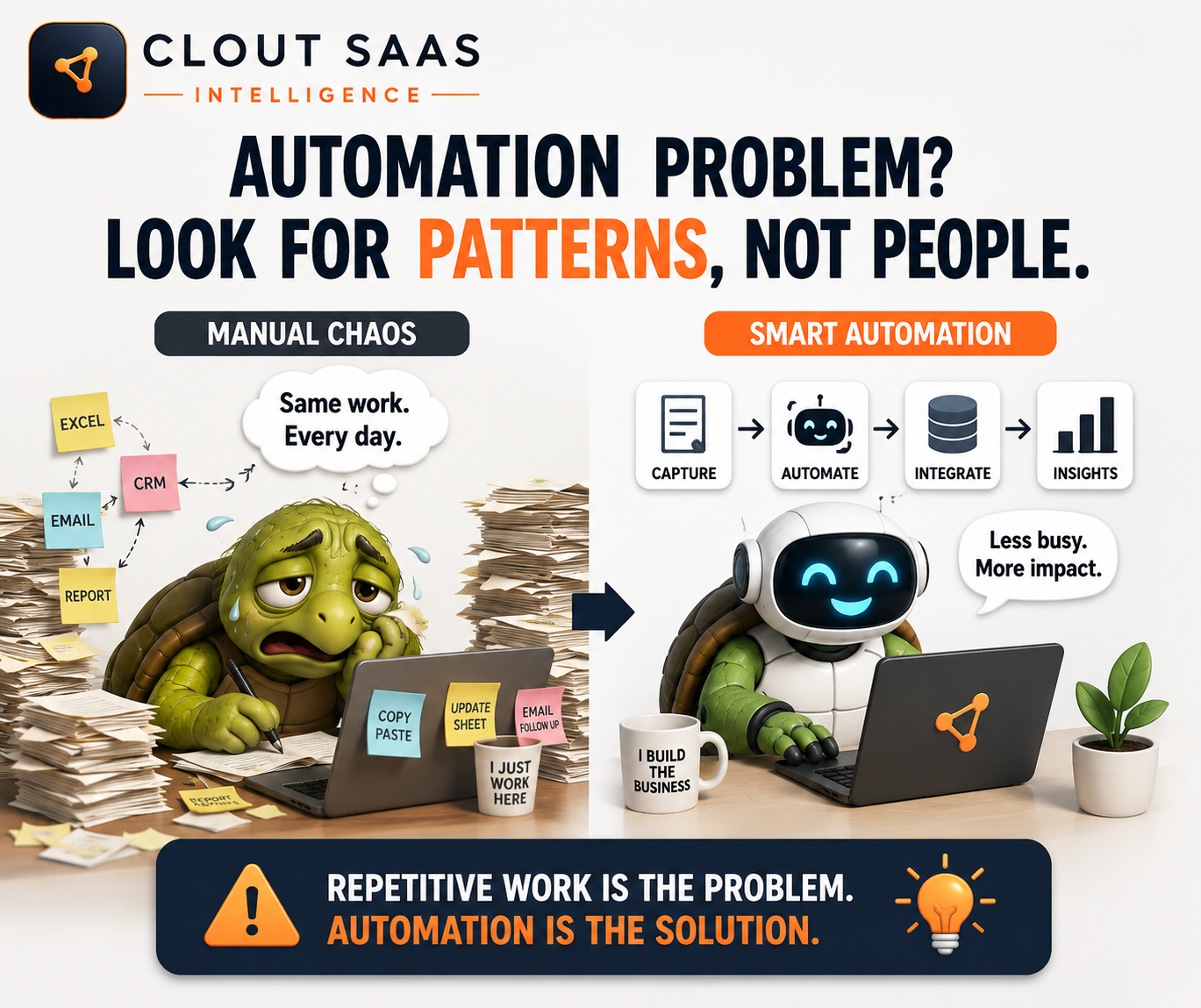
Most founders think an automation problem means: We are not using enough AI. That is usually the wrong diagnosis.
An automation problem exists when people are repeatedly doing predictable work that technology could handle more efficiently.
Look for these warning signs.
1. Your team keeps copying the same data If information moves manually between Excel, CRM, email, accounting software, or other systems, you probably have an integration problem disguised as a people problem.
2. Employees spend hours preparing reports If managers spend Monday morning collecting numbers instead of discussing what the numbers mean, your reporting process needs attention.
3. The same customer questions keep reaching employees If your team repeatedly answers questions that follow predictable patterns, you may be paying people to perform a process that could be partially automated.
4. Follow-ups depend on someone's memory When sales calls, invoices, approvals, or customer requests require someone to remember what to do next, the process is fragile.
5. Adding revenue requires adding people This is the biggest warning sign.
If every increase in customers creates a proportional increase in administrative workload, your processes are not scaling with the business.
But here is the contrarian part. Do not automate immediately.
First ask:
Why does this task exist?
- Some processes contain unnecessary steps.
- Some require better data.
- Some need system integration.
- Some genuinely require human judgment.
Automating a bad process simply makes the bad process faster.
The real objective is not to have more automation. It is to build a business where people spend their time on decisions, relationships, creativity, and problems that actually require human judgment.
So before your next automation project, audit your team's work.
Find the repetitive tasks. Measure the time they consume. Identify the business impact. Then automate the highest value opportunities first.
Your biggest automation opportunity may not be the task that takes the most time. It may be the task that repeatedly prevents your best people from doing higher value work.
If you removed one repetitive process from your business tomorrow, which one would create the biggest impact?
#BusinessAutomation #ArtificialIntelligence #BusinessStrategy #Founder #Entrepreneurship #OperationalEfficiency #WorkflowAutomation #DigitalTransformation #AIForBusiness #BusinessGrowth #Productivity #FutureOfWork #CloutSaaSIntelligence #CloutSaaS